
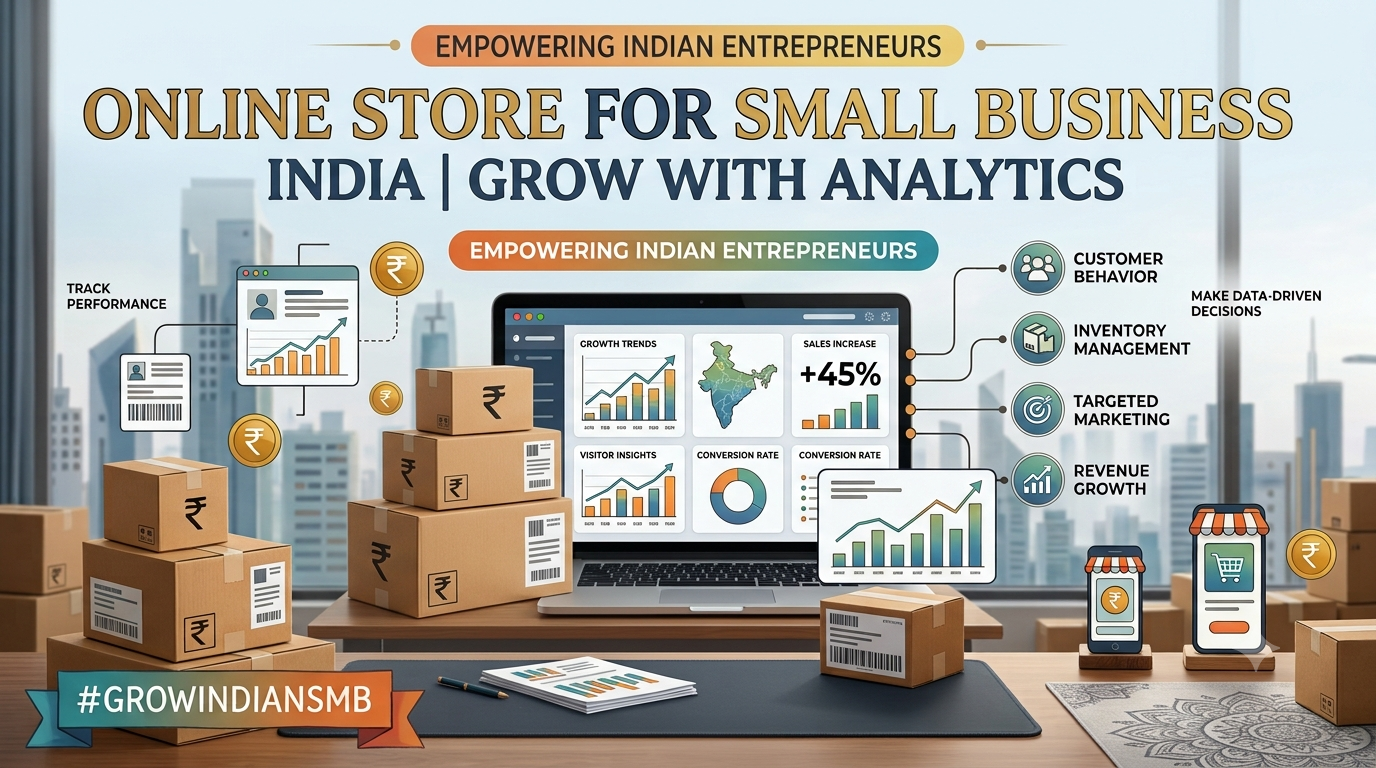
Online Store for Small Business India: Grow Sales With Data
 Your shop can take orders even after the shutter comes down.
Key takeaways
An online store for small business in India lets you sell 24/7 to customers across the country, not just walk-ins in your area.
Your own D2C store reduces dependence on marketplace commissions and gives you direct customer relationships and data.
Sales analytics show which products make money, where customers drop off, and which cities you're missing.
Tracking RTO, COD vs prepaid and repeat customers helps you cut losses and grow profit, not just orders.
You can start small: set up a store, share it on WhatsApp and Instagram, and review your first analytics report within a few weeks.
Most small sellers in India work hard every day but still depend on the same few things: walk-in customers, WhatsApp orders from known contacts, or a marketplace that takes a cut of every sale.
And when sales drop, it's hard to know why. Was it the product? The price? The season? Or were customers leaving before they paid?
This guide answers two simple questions. First, how does an online store for small business help you grow beyond your shop and your city? Second, how can sales analytics show you the exact gaps in your business, so you know what to fix?
No jargon. Just practical steps you can use, whether you run a kirana store, a wholesale business, or an Instagram boutique.
What Is an Online Store and Why Does Your Business Need One?
An online store is your own website where customers can browse your products, place orders and pay online, without visiting your shop.
Think of it as a second shop that never closes and has no rent for extra floor space. Customers from anywhere in India can find you, order, and get the product delivered to their door.
Why does it matter now? Indian shoppers, including in Tier 2 and Tier 3 cities, are increasingly comfortable buying online and paying with UPI. According to NPCI's UPI statistics, UPI now handles billions of transactions every month, which means your customers already know how to pay you digitally.
If your business is only offline or only on WhatsApp, you're missing customers who are already searching online.
7 Ways an Online Store Boosts Your Business
An online store boosts your business by bringing more customers, better margins and more control. Here's how.
1. You Can Sell 24/7
Your online store takes orders even when your shop shutter is down. Customers often shop late at night or on Sundays, and your store is ready for them.
Example: A saree seller in Surat closes her shop at 9 pm. With an online store, she wakes up to orders placed between 10 pm and midnight, when working women finally have time to browse.
2. You Reach Customers Beyond Your City
An online store removes the limit of your local area. With courier partners, you can deliver to lakhs of pin codes across India.
Example: A brass handicraft seller in Moradabad used to sell only to wholesale buyers who visited in person. Online, he can sell directly to home décor buyers in Bengaluru, Pune and Guwahati.
3. You Depend Less on Marketplace Commissions
Your own store means fewer marketplace commissions and fee deductions on every order. You still pay for things like payment processing and shipping, but you decide your pricing and margins.
This is the core idea behind a D2C online store India sellers are adopting: sell directly to consumers instead of through a middleman. You can keep selling on marketplaces too, but you're no longer fully dependent on them.
Example: A Jaipur blue pottery brand keeps its marketplace listings but pushes repeat customers to its own store, where each order earns a better margin.
4. You Own Your Customer Data
On your own store, you know who bought, what they bought and how to reach them again. On many marketplaces, the customer belongs to the platform, not you.
Example: An Indore namkeen seller uses his customer list to send a WhatsApp message before Diwali. Past buyers reorder gift packs without any ad spend.
5. You Build Your Own Brand
A store with your name, logo and story makes customers remember you, not just the product. Brands get repeat orders and word-of-mouth; unbranded listings compete only on price.
Example: A Kolhapuri chappal maker in Kolhapur builds a branded store with photos of his workshop. Customers now search for his brand name instead of "Kolhapuri chappal cheap."
6. You Get Online Payments and Faster Cash Flow
Online payments through UPI, cards and wallets mean money reaches you faster and with less risk than cash on delivery. Prepaid orders also tend to have fewer cancellations.
Example: A Tiruppur T-shirt wholesaler starts offering a small discount for prepaid orders. More customers pay upfront, and his cash is no longer stuck in COD cycles.
7. You Combine Offline and Online Sales
An online store works alongside your physical shop, not against it. Walk-in customers can reorder online, and online customers can visit your shop.
Example: A Ludhiana woollens shop puts a QR code at the billing counter. Winter customers scan it, and many reorder online the next season without visiting.
 A QR code at the counter turns walk-in buyers into online repeat customers.
How Sales Analytics Help You Find Gaps in Your Business
Sales analytics show you what's really happening in your business, using numbers instead of guesswork. Each report points to a gap you can fix. [INTERNAL LINK: sales analytics feature page]
 A simple dashboard shows bestsellers, slow stock and where your orders come from. (Illustrative data)
Here's how to read the most useful ones.
Best-Selling vs Dead-Stock Products
Analytics show which products sell again and again, and which just sit in your godown.
- What the data shows: A small share of your products may bring most of your sales.
- Gap it reveals: Money locked in slow-moving stock.
- Action: Restock bestsellers first. Bundle or discount dead stock to clear it.
Where Customers Drop Off (Cart Abandonment)
Analytics show how many people add items to their cart but don't pay.
- What the data shows: Many visitors reach the checkout page and leave.
- Gap it reveals: High shipping charges, few payment options, or a confusing checkout.
- Action: Show delivery charges early, offer UPI and COD, and send a reminder message to abandoned carts.
Which Cities and Regions Buy Most
Analytics show where your orders come from, and where they don't.
- What the data shows: Most orders come from 3–4 cities.
- Gap it reveals: Regions with interest but low sales, possibly due to slow delivery or no local marketing.
- Action: Target missing regions with Instagram posts or WhatsApp campaigns, and check courier coverage there.
Return, RTO and COD vs Prepaid Patterns
Analytics show which orders get returned or refused at the door (RTO, or Return to Origin).
- What the data shows: RTO is often higher on COD orders and in certain pin codes.
- Gap it reveals: You're paying shipping both ways on orders that never convert.
- Action: Confirm COD orders by WhatsApp or call, reward prepaid payments, and restrict COD in high-RTO pin codes.
 Compare RTO by payment type and zone to spot where COD is costing you. (Illustrative data)
Peak Sales Days, Times and Festive Seasons
Analytics show when your customers shop most.
- What the data shows: Spikes before Diwali, Raksha Bandhan or weekends, and at certain hours.
- Gap it reveals: Running out of stock during peaks, or posting offers when nobody's online.
- Action: Stock up 3–4 weeks before festivals and schedule posts and offers for your peak hours.
Repeat vs One-Time Customers
Analytics show how many customers come back after their first order.
- What the data shows: Most buyers order only once.
- Gap it reveals: You're spending to find new customers but not keeping them.
- Action: Send a thank-you message, offer a second-order discount, and share new arrivals with past buyers.
A Simple Table: Business Question → Metric → Action
| Business question | Metric to check | Action to take |
|---|---|---|
| Which products make me money? | Sales and profit by product | Restock winners, clear dead stock |
| Why aren't visitors buying? | Cart abandonment rate | Simplify checkout, show charges early |
| Where are my customers? | Orders by city/state | Market to strong and missing regions |
| Why am I losing money on shipping? | RTO rate by payment type and pin code | Confirm COD orders, push prepaid |
| When should I run offers? | Sales by day, hour and season | Stock up before festivals, time your posts |
| Are customers coming back? | Repeat customer rate | Follow-ups and second-order offers |
| Is my average order too small? | Average order value (AOV) | Create combos and bundles |
| Which channel brings buyers? | Orders by source (WhatsApp, Instagram, direct) | Spend time on channels that convert |
How to Get Started (Step-by-Step)
You can take your shop online in a few simple steps, even if you've never used a website builder before.
 Add products, turn on payments, connect shipping, share your link.
- List your products. Start with your 20–30 best sellers. Take clear photos in daylight and write simple descriptions with size, material and price.
- Set up your online store. Choose a platform built for Indian sellers. For example, TheShopMate lets you launch your own branded store with online payments and shipping built in.
- Turn on payments. Enable UPI, cards and wallets. Decide whether to offer COD and for which pin codes.
- Connect shipping. Pick courier partners that cover your target regions. TheShopMate offers 40+ courier integrations, so you can compare options from one dashboard.
- Share your store link. Post it on WhatsApp Business, your WhatsApp status, Instagram bio and on a QR code at your shop counter.
- Get your first orders. Start with existing customers. Ask them to order online once and share feedback.
- Read your first analytics report. After 2–4 weeks, check your top products, cities, cart abandonment and RTO. Pick one gap and fix it.
- Repeat every month. Review your numbers monthly and before every festive season.
Frequently Asked Questions
Do I need an online store if I already sell on WhatsApp?
Yes, an online store makes WhatsApp selling easier. Instead of sending photos and prices one by one, you share a single link where customers browse, order and pay themselves. You save time, avoid missed messages, and get order data you can use to grow. WhatsApp stays your chat channel; the store handles orders.
How much does it cost to start an online store in India?
Costs depend on the platform and features you choose. Typically you pay for the platform plan, payment gateway fees per transaction, and shipping per order. Some platforms charge monthly fees, others take a share of sales. Always check total cost per order, not just the plan price. Check our Price
Is an online store better than selling on Amazon or Flipkart?
They serve different purposes, and many sellers use both. Marketplaces bring ready traffic but charge fees and keep the customer relationship. Your own store gives you better margins, your own brand and customer data, but you bring the traffic. A common approach is marketplaces for discovery and your store for repeat buyers.
What analytics should a small business track?
Start with six numbers: best-selling products, cart abandonment rate, orders by city, RTO rate, COD vs prepaid share, and repeat customer rate. These show where you make money and where you lose it. Review them monthly and before festive seasons, then fix one gap at a time.
Can I run my offline shop and online store together?
Yes, and it often works better than running either alone. Your shop builds trust locally, while your online store reaches new customers and lets regulars reorder from home. Keep prices and stock in sync, put a QR code at your counter, and track sales from both channels together.
How do I reduce returns and RTO for online orders?
Confirm COD orders on WhatsApp or by call before shipping, and offer a small discount for prepaid payments. Use clear photos, accurate size charts and honest descriptions to prevent returns. Check your analytics for high-RTO pin codes and limit COD there. Faster delivery also reduces refused orders.
How do I take my shop online without technical knowledge?
Use a ready-made store platform instead of building a website from scratch. Most let you add products, set prices and turn on payments from a simple dashboard or phone. Start with a few products, share the link with existing customers, and add more as you learn what sells.
Conclusion
An online store for small business in India is no longer a "big company" thing. It helps you sell around the clock, reach customers far beyond your city, depend less on marketplaces and build a brand people remember.
But the real advantage is data. Sales analytics show you which products earn, where buyers drop off, which cities you're missing and how to cut RTO losses.
Start small, check your numbers monthly, and fix one gap at a time.
Ready to take your shop online?
See how TheShopMate fits your business in a free, no-pressure demo.
Further reading: IBEF — E-commerce Industry in India